




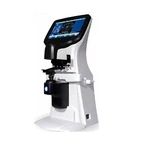

Refractometer, which examines the aggregation of light entering the eyeball. It measures the degree of vergence difference between the eye under test and the emmetropic eye based on the state of the emmetrope.
Optometry is the main method to identify refractive errors, and it occupies a considerable amount of work in clinical work. The traditional method of retinoscopy in the past is time-consuming and labor-intensive, and it is extremely difficult to master. After the 1970s, a new type of automatic refractometer came into being, using infrared, electronic, computing and other technical means to check the aggregation of light entering the eyeball.
Refractometer optometry can be used as diagnostic optometry for the fitting of soft contact lenses, which does not require pupil dilation and can quickly measure the degree of refraction. The optometry results of the refractor are all printed automatically without conversion. Generally, a patient can be measured in a few seconds to a few minutes, and the degree of refractive error can be quickly measured, providing more accurate refraction and interpupillary distance for lens correction.
The accuracy of the refractometer is affected by many factors, for example, the patient's head and eyes are not well coordinated, they move around, the eyes are not focused enough on the target in the refractor, so that the relaxation adjustment is not enough, which will inevitably affect the accuracy of the refraction test results, and even The degree of repeat inspection varies widely. For children and patients with refractive interstitial opacities, the error of the computerized refractometer test is relatively large, and even the refraction cannot be detected. Therefore, it is inappropriate to use the computer-measured diopter as the sole basis for glasses. Computer optometry can not replace the retinoscopy and lens correction technology, only to provide a useful reference for manual optometry.
The refractometer can quickly measure the general situation of refractive error, which can provide a useful reference for understanding the degree of refraction of consumers and a large number of outpatient optometry.