




Lensmeter
What is Lensmeter
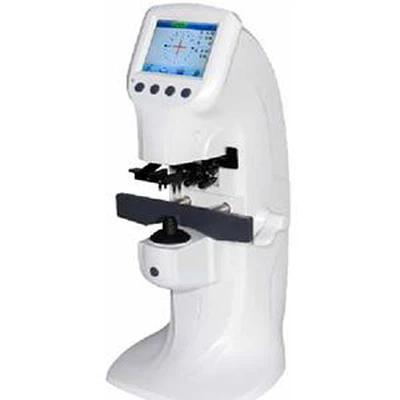
A lensmeter or lensometer (sometimes even known as focimeter or vertometer) is an optical instrument used in ophthalmology. It is mainly used by optometrists and opticians to measure the back or front vertex power of a spectacle lens and verify the correct prescription in a pair of eyeglasses, to properly orient and mark uncut lenses, and to confirm the correct mounting of lenses in spectacle frames. Lensmeters can also verify the power of contact lenses, if a special lens support is used.
Benefits of Lensmeter
Hartmann sensor with more than 100 measurement points
535 Nm wavelength (Green measurement light)
Faster measurement
Virtual PD measurement
UV measurement function and printer optional
Data transferred facility available to Sight Tester/ Phoropter.




Why Choose us
Professional service
We can accept factory inspection and goods inspection at any time. Technical discussion, research and development of new products, and complete after-sales service.
Speed
Our organization is streamlined for fast turnaround on orders and immediate response to emergencies or unexpected opportunities.
Fantastic customer service
Nothing is more important to us than customer satisfaction. With our ‘can-do attitude’ we ensure our customers’ expectations are exceeded at all times – from delivering great solutions on time to providing advice and resolving queries as quickly as possible.
Quality and satisfaction
Taiyuan North China Xinyuan Tech Center(CO., LTD.)
The company has a complete quality management system and various qualification certificates.
Horizontal
Step1: Place the glasses on the patient
With a felt-tipped pen, mark the center of the patient's pupil
Vertical positioning is negligible but should be closed
Step2: Center the mark for the right lens on the lensmeter
Remove any vertical displacement
Step3: Any remaining deflection in the x-axis is the amount of horizontal prism for this lens
Notice the rings that are numbered, each ring represents a degree of the prism, the direction of the prism in the direction of mires are when focused ( can be up or down for vertical )
Record the eye, amount, and direction (i.e., 2.5∆ BO OD)
Step4: Repeat for the left lens
Step5: Total horizontal prism is the sum of each eye's prism
Bases in the same direction are additive (BO/BO or BI/BI)
Bases in the opposite direction are subtractive (BO/BI or BI/BO)
Vertical
Step1: Measure lens powers
Determine which lens has the highest power in the vertical meridian
The highest-powered lens will be the reference lens
Step2: Center the target lines on the center of the reticle
Move the lens table so that the eye wire is not resting on the lens table
Step3: Without moving the lens table, slide the other lens onto the lens stop
Position the second lens so that there is no horizontal prism
Rotating the reticle so the “ cross-line “ is vertical makes this procedure easier
The remaining vertical displacement is the vertical prism present in the glasses
Step4: Record the amount, base direction, and eye when specifying vertical prism
This will give you the total prism in the glasses. Often prism is split between both eyes
Transposition
Sometimes prescriptions come in the plus cylinder; however, optometry works in neutralizing lenses in minus cylinder form. To convert the lens prescription to a minus cylinder form is called transposition.
Transposition can also be used to transpose the minus cylinder into the plus cylinder.
Step 1:Algebraically subtract the cylinder from the sphere power; this will be the sphere power of the lens
Step 2:Change the power sign of the cylinder (the power will remain the same)
Step 3:Add 90 degrees to the axis

Turn on llensmeter: Turn on the power switch.
Adjust the angle of the lensmeter:Position the lensmeter at a comfortable angle using the lever near the back of the lensmeter.
Focusing the eyepiece: Adjust the eyepiece to compensate for examiner's own refractive error. The following steps should be followed without a lens in place: Look into the eyepiece. Rotate the power wheel until the lines are out of focus. Turn the eyepiece in a plus direction, typically counterclockwise. Turn the eyepiece slowly in the opposite direction, typically clockwise, until the target comes into focus. If turned past this point, the measurer's accommodation will be introduced, thus skewing the reading. Rotate the power wheel to focus the lines. The lines should come into focus at a reading of 0 on the power wheel. If this is not the case, repeat the previous steps. If distance spectacles or contact lenses are used by the examiner to focus the eyepiece, they should be worn each time the lensmeter is used.
Positioning the lens:Place the spectacles on the moveable reticle in between the lens stop and lens holder with the temple facing away from the measurer. The bottom rims of both lenses should be placed on the lens holder and the 180˚ line should be paralleled to the reticle. While looking into the eyepiece, adjust the lens so that the lines cross in the center of the target by moving the lens on the reticle. This establishes the optical center, which can be marked with the marking pen. The addition power can be located and marked by examining the lenses under a polariscope. In general, the added spherical power for near vision in bifocal, trifocal, and progressive lenses are located on the lateral side of the spectacles.
The Parts Of A Lensmeter Include
The eyepiece: It is mounted in a screw-type focusing mechanism. It plays an important role in the accuracy of your readings and is essential due to the different focusing ability of the individual eye of each user. It may be fitted with a rubber guard to prevent scratching of the user's own eyewear.
Chrome Knurled Sleeve: It is used to rotate the Reticle to orient prism base.
Prism Compensating Device Knob: It is used to read prism amounts greater than five prism diopters.
Lens Holder Handle: It is used to hold a lens in place against the aperture.
Marking Device Control: It is used to spot the lens at either the Optical Center or Prism Reference Point (PRP).
Gimbal: It is a pivoting holder that holds the lens in place.
Ink Pad: It holds the spotting ink.
Spectacle Table Lever: It is used to raise, or lower the level of the spectacle table.
Spectacle Table: It is the resting place for the frame when neutralizing finished eyewear.
Power Drum: It is a hand wheel with numbered scale readings between +20 and -20 D.
Locking Lever: It is used to elevate or depress the position of the instrument for individual's height or posture.
Prism Axis Scale: It is used for orientation of prism axis
Prism Compensating Device: It is used to verify or layout large amounts of prism.
Prism Diopter Power Scale: It displays prism amount.
On-off Switch: It is the power switch.
Lens Stop: It is the aperture against which the lens rests.
Cylinder Axis Wheel: It is used to orient or neutralize cylinder axis.
Filter Lever: It is used to engage or remove green filter.
A lensmeter or lensmeter denotes an ophthalmic expedient. Occasionally, the lensmeter has been named a focimeter or vertometer. The actions and methods that are used for working a lensmeter made by the lensmeter manufacturers are mentioned as lensometry or focimetry. The lensmeter is usually used for confirming the precise outline of a pair of eye lenses by optometrists and opticians. The lensmeter helps angle properly and mark unabridged lenses, confirming the power of single apparition, bifocal and trifocal lenses, and checking the right escalating of eye lenses in sight mounts. The expedient is used by the ophthalmologists or optometrists to evaluate certain strictures stated on the patient s preparation, such as roll, axis, scope, add, and in some cases, prism. This instrument is often used to verify the accuracy of progressive lenses. It is also used to regulate and mark the midpoint of a lens and several other corporal measurements that are vital for the proper working of the lens.
A lens having a pivotal length (f) is used to duplicate a board (typically a traversed set of shapes). The user then positions the sight lens (under examination) at the lens s rear principal point (f). The light emissions evolving from the sight lens then pass into an eyepiece having an inner reticle. The board is axially removed concurrently by the user until it is in emphasis with the reticle. Then, a state befalls when the light emissions evolving from the examination sight lens become collimated. The cleavers of a spherocylinder lens can be united by revolving the board.

Types of Lensometer
Manual lensmeter: Manual lensmeter can be defined as an instrument used by an optometrist to find the back-vertex or the front vertex power of the eyeglasses. A manual lensometer is portable and can be carried anywhere. But a person needs to have a better idea to measure the power of a lens.
Automated lensmeter: It is a fully automatic well-programmed device primarily used in clinics. It is easy and faster and can print prescriptions. It is less accurate when compared to a manual lensometer.
Daily Care And Maintenance Of Lensmeter
Precautions for use environment
The lens meter should be used indoors, without direct sunlight and installed in a level and stable place that is not easy to get wet. Due to the limited store area, many optical shops usually put edge grinding machines, slotting machines and other processing equipment together. Over time, the water spray and dust generated when the edger is working will stick to the focal meter, which will easily cause a short circuit of the instrument and cause a circuit failure. So the focal meter should be placed away from the processing equipment. When using the focal meter, you should pay attention to whether it is affected by the light of the store display cabinet to ensure the normal operation of the machine.
Precautions during use
The instrument is turned on and warmed up. Before use, check whether the optical path is unobstructed, otherwise it will lead to failure to enter the measurement interface normally. If the interface cannot be entered normally or an error is reported, check whether the protective cover on the lensometer measurement support is covered. There are also some older lensmeters that have been used for a long time, and the spring of the dot needle is loose and naturally droops, which blocks the optical path and causes abnormal startup.
Maintenance of protective glass
When in use, if you find that the lens meter display mark keeps moving or moves slowly or abnormal data, you should check whether the lens support seat is stable and whether the lens clamp is loose. Next, check whether there is any foreign matter on the focus cover, take out the focus cover, and observe whether there is dust on the lower protective glass. If you find any foreign matter blocking, you can blow off the dust with an air blower, if you still find that it cannot be removed, you can wipe it with a clean and soft eye cloth.
Our Factory
Being more than 30 years, now we are a leading manufacturer of optical instruments in China. We have large quantities of professional technicians and skilled workmen. Many advanced optical-electricity equipments are used in the technological process. Depending on the scientific research advantage of North University of China, we have developed a multi factorial and multi directional produce, management and sale system.

Our Certificate
Taiyuan North China Xinyuan Tech Center(CO., LTD.) is a professional company that produces "Xinyuan" brand glasses industry test equipment.
The company has a complete quality management system and various qualification certificates.

Asked Questions
As one of the leading lensmeter manufacturers in China, we warmly welcome you to buy high-grade lensmeter for sale here from our factory. All customized products are with high quality and competitive price.
JD 2600 Auto Lensmeter, lensmeter huvitz, lens edger machine