



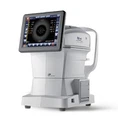

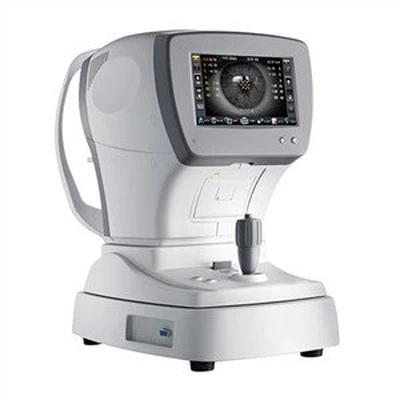
Refractometer
What is Refractometer
A refractometer is a computer-controlled machine used during an eye examination to provide an objective measurement of a person's refractive error and prescription for glasses or contact lenses. This is achieved by measuring how light is changed as it enters a person's eye.
Benefits of Refractometer
High precision and accuracy
The refractometer uses cutting-edge technology to measure refractive errors with unparalleled accuracy and precision. The device's automated process ensures consistent and reliable results, eliminating the variability and human error that can occur with manual refractometers.
Fast and efficient measurement
With the refractometer, you can measure refractive errors in a matter of seconds, allowing you to serve more patients in less time. The device's rapid measurement speed, combined with its high accuracy, makes it an excellent choice for busy eye care practices.
User-friendly interface
The refractometer features a user-friendly interface that makes it easy to operate, even for those who are not tech-savvy. The device's touchscreen display and intuitive menu system allow for effortless navigation and operation.
Automated data management
The refractometer incorporates sophisticated software that automatically saves and manages patient data, making it easy to access and analyze. The device can store up to 10,000 patient records, allowing you to track changes in refractive error over time.
Advanced connectivity options
The refractometer offers advanced connectivity options, allowing you to integrate it seamlessly into your practice's existing software systems. The device can connect to a computer or network via USB, LAN, or Wi-Fi, enabling easy data transfer and remote management.



Why Choose us
Professional service
We can accept factory inspection and goods inspection at any time. Technical discussion, research and development of new products, and complete after-sales service.
Speed
Our organization is streamlined for fast turnaround on orders and immediate response to emergencies or unexpected opportunities.
Fantastic customer service
Nothing is more important to us than customer satisfaction. With our ‘can-do attitude’ we ensure our customers’ expectations are exceeded at all times – from delivering great solutions on time to providing advice and resolving queries as quickly as possible.
Quality and satisfaction
Taiyuan North China Xinyuan Tech Center(CO., LTD.)
The company has a complete quality management system and various qualification certificates.
Types of Refractometer
Manual
Who doesn't know the term "Manual." It reflects that the device is not automatic. Instead, the ophthalmologist has to operate it manually. By that means, it requires operational skills along with medical skills.
So, what precisely is a manual refractometer is?
A manual refractometer is a device used to assess the patient's eyesight and search the refractive errors. So, what is a refractive error?
Refractive error refers to the formation of an image on the retina after refraction. If the picture doesn't focus on the retina, do you know what that means?
It means you have myopia, hypermetropia, or astigmatism. All these vision errors are refractive errors requiring the essential measures to rectify them.
Automatic
An automatic refractometer is another type of refractometer. The auto refractometer is an automated device that doesn't require any manual measurements. Everything works automatically and measures the refractive errors from different angles.
If astigmatism is, you can correct it with cylindrical lenses and treat it with time.
Semi-Automatic
A semi-automatic refractometer facilitates the optometrists with the refractive error measurements but requires both manual control and automatic process. In simple words, a Semi-automatic refractometer is in between the manual and auto refractometer.
Advancements in Refractometer Technology
Digital and Automated Features
Refractometer incorporate digital and automated features that enhance their functionality. These devices can store and analyze patient data, integrate with electronic health records (EHR) systems, and provide detailed reports. Digital refractometer improve the accuracy and efficiency of eye exams.
Automation in refractometer minimizes the need for manual adjustments, reducing the potential for human error. These devices can quickly adapt to different patient needs, providing consistent and reliable measurements. Digital readouts and automated printouts streamline the diagnostic process.
Integration with Diagnostic Tools
Refractometer are often integrated with other diagnostic tools such as keratometers and corneal topographers. This integration allows for a comprehensive assessment of the patient's visual health. By combining multiple diagnostic functions, refractometer provide a more complete picture of the eye's condition.
The integration of refractometer with other diagnostic tools enhances the accuracy of refractive measurements. These devices can simultaneously assess refractive error and corneal curvature, providing valuable data for contact lens fitting and refractive surgery planning.
Advanced Imaging Capabilities
Recent advancements in autorefractor technology include enhanced imaging capabilities. Some refractometer are equipped with high-resolution cameras that capture detailed images of the eye's structure. These images can be used to diagnose and monitor a range of eye conditions.
High-resolution imaging allows optometrists to detect subtle changes in the eye's anatomy, leading to earlier diagnosis and treatment of conditions such as keratoconus and cataracts. Advanced imaging capabilities make refractometer a versatile tool in comprehensive eye care.
Essential Skills for Using an Refractometer
Technical Proficiency
Operating an refractometer requires technical expertise and familiarity with its various functions. Optometrists must understand how to align the device, interpret the measurements, and ensure accurate results. Mastery of these technical skills is crucial for performing precise and effective eye exams.
Technical proficiency also involves maintaining and calibrating the refractometer. Regular maintenance ensures the device operates correctly and provides accurate measurements. Optometrists must be knowledgeable about troubleshooting common issues and performing routine upkeep.
Patient Communication
Effective communication is essential for gathering accurate information from patients. Optometrists must explain the examination process clearly and ensure the patient understands the importance of maintaining a steady focus. Building rapport with patients encourages cooperation and accurate feedback.
Patient communication also involves discussing the results of the refractometer exam. Optometrists must explain the findings in a way that is easy for patients to understand and discuss the next steps for treatment. Clear communication fosters trust and enhances the patient experience.
Diagnostic Interpretation
Interpreting the results of an refractometer exam requires a deep understanding of ocular physiology and refractive errors. Optometrists must analyze the measurements and integrate them with other diagnostic data to make informed decisions about treatment. This analytical skill is key to providing high-quality eye care.
Diagnostic interpretation involves comparing the refractometer results with subjective refraction findings. Optometrists must consider factors such as patient age, eye health, and visual needs when determining the final prescription. Accurate interpretation ensures effective vision correction.

Assessing Visual Acuity
Visual acuity assessment is a fundamental component of comprehensive eye exams. Refractometer are instrumental in determining the sharpness and clarity of a patient’s vision. By providing accurate measurements, optometrists can identify the best correction for each eye, ensuring that patients achieve optimal visual acuity.
This process involves capturing precise measurements of refractive errors and using these data points to refine the prescription. Accurate visual acuity assessments are crucial for diagnosing refractive errors and prescribing effective corrective lenses.
Evaluating Binocular Vision
Refractometer are also used to evaluate binocular vision, which is the ability of both eyes to work together effectively. Binocular vision assessments help diagnose conditions such as strabismus (misalignment of the eyes) and amblyopia (lazy eye). These conditions can affect depth perception and overall visual function.
By using refractometer with integrated binocular vision testing capabilities, optometrists can measure how well the eyes coordinate and align. Detecting and treating binocular vision problems early is essential for preventing long-term visual impairment and ensuring that patients maintain healthy vision.
How Does the Refractometer Work?
Refractometer only take a few moments to determine each measurement for each eye. What's more, refractometer are quite reliable and are sometimes used in conjunction with a machine called a phoropter to manually switch lenses in front of your eyes to provide ideal vision correction.
While seated in front of the refractometer, you'll be asked to focus on an image or point of light. The refractometer automatically determines the correction needed to place your “focus point” on top of the retina, the light-sensitive area at the back of the eye responsible for correctly processing images.
The measurement taken by an refractometer can be translated into a prescription for eyeglasses.
How Is Autorefraction Done?
Autorefraction is usually carried out during the pre-test part of your visit, before you go in to see the optician.
You'll be asked to sit in front of the machine, put your chin on the rest and look into the machine. You'll be asked to look at an image, or stay focused on a point of light, while the refractometer takes its measurements. It does this by making the picture appear closer and further away; as it does this, it estimates your prescription by how well your eyes focus on the image. You won't need to do anything but keep looking ahead until we've got what we need — it'll only take a few seconds.
The results will be sent through to the optician for them to use during your exam where they'll carry out a couple more tests manually to make sure you get the most accurate prescription.
Common Refractometer Repair Issues
Electrical
Device is not turning ON – It could be power cord problem, power switch failure or blown fuse.
LCD display does not function properly – You may be seeing a black screen, white screen or blurred screen. The screen may intermittently disappear or start rolling as shown below.
Indicator lamp failure
Mechanical & Control Systems
Main body of the machine is not moving properly – up/down or lateral movement is impacted
Printer is not working
Locking structure malfunction
Poor Key response or buttons not functioning
Measurement accuracy & calibration problems
Device refraction results (spherical power, astigmatism power or PD value) are not accurate or consistent- requires calibration
Keratometry does not work, or is not accurate or consistent
How to Maintain Refractometer
Maintenance and Warranty
First, check the maintenance and warranty information for each piece of refractometer. Manufacturer’s details, service manuals, and warranty specifics can help you build a schedule for each item. Create a timetable based on each piece of refractometer best practices so that your team has a clear understanding of when maintenance should be completed. An overarching timetable should include weekly and monthly tasks (dusting, checking bulbs, safety checks, lubrication) as well as less frequent tasks such as recalibrations and repairs by service agents.
Make sure every employee understands the history and limitations of each piece of refractometer as well as how to maintain each piece in a way that will preserve it in good order for years to come.
Maintenance and Repair Record
Keeping a maintenance and repair record is critical to helping you stay on top of routine maintenance. Accurate and detailed records will assist you in highlighting recurring issues, remembering common fixes, and communicating successfully with the vendor or service provider. Each piece of refractometer in your office will have a unique personality. The better the documentation of each quirk, the easier it will to be maintain and repair them along the way. Your maintenance and repair record should cover:
The history of every piece of refractometer, including dates of each service call or replacement part and the outcome of each instance
Common issues affecting each piece of refractometer and their associated solutions
An updated inventory of spare parts within the clinic and a reordering schedule
Warranty information and service desk phone numbers for each piece of refractometer
The name of each staff member who conducted the maintenance or placed the service call, and the date on which that call took place
Limitations and specifications of each piece of refractometer (temperatures, calibrations, etc.)
Our Factory
Being more than 30 years, now we are a leading manufacturer of optical instruments in China. We have large quantities of professional technicians and skilled workmen. Many advanced optical-electricity equipments are used in the technological process. Depending on the scientific research advantage of North University of China, we have developed a multi factorial and multi directional produce, management and sale system.

Our Certificate
Taiyuan North China Xinyuan Tech Center(CO., LTD.) is a professional company that produces "Xinyuan" brand glasses industry test equipment.
The company has a complete quality management system and various qualification certificates.

Asked Questions
As one of the leading refractometer manufacturers in China, we warmly welcome you to buy high-grade refractometer for sale here from our factory. All customized products are with high quality and competitive price.
FA 6100A Auto Kerato refractometer, refractometer salinity unit, FA 6100B Auto Refractometer Auto Kerato refractomete