




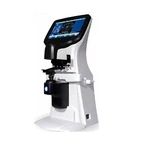

The traditional hand-held sugar meter/refractometer is simple to operate and easy to carry, and is generally used in the determination of sugar content in the food industry such as beverages and cans. However, the hand-held sugar meter obtains the sugar content of the solution sample by observing the eyepiece with the naked eye and reading the degree of the scale line in the field of view, and there is no temperature measurement/temperature control system, so it has certain limitations. With the rapid development of science and technology and the iterative update of analytical instruments, more and more high-accuracy, multi-functional digital sugar meters/refractometers have appeared, with intuitive readings, high resolution, automatic temperature compensation, and fast detection speed. and other advantages, gradually replaced the hand-held sugar meter. The scope of application of refractometers has gradually covered food, cosmetics, petrochemical, medical and pharmaceutical industries.
However, there are currently no verification procedures, specifications and standards for such instruments. Domestic manufacturers only provide instruction manuals and enterprise standards for their own instruments. There are no uniform standards for the use conditions, measurement methods and technical indicators of instruments. In order to ensure the accurate and traceable value of the quantity, and to promote the smooth progress of the strong inspection of the digital sugar meter, it is necessary to formulate corresponding verification procedures to provide a technical basis for the measurement and verification of such instruments.
Check environmental conditions:
1. Ambient temperature: (20±2)℃.
2. Relative humidity: ≤85%.
3. Power supply voltage (220±22)V, frequency (50±1)Hz, and good grounding.
4. The instrument should be placed on the workbench smoothly, and there should be no obvious shock and vibration, and there should be no strong electromagnetic field interference nearby.
5. The verification site should be well ventilated, without the influence of thermal radiation, and there should be no flammable, explosive and corrosive gases.
Verification standard and supporting equipment:
1. Digital thermometer: measuring range (0~100)℃, maximum allowable error ±0.2℃. 2. Electronic balance: the division value is not more than 0.1mg, and the accuracy level is grade ①. 3. Indexing pipette or single-marked pipette, single-marked volumetric flask: accuracy grade A. 4. Pure water: It meets the requirements of secondary water specifications in GB/T 6682 "Specifications and Test Methods for Analytical Laboratory Water".
Verification period:
The verification period of the instrument is generally not more than 1 year. During this period, when the instrument is repaired or has doubts about the measurement results, it should be checked in time.