




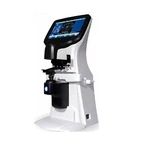

The refractometer is an instrument that can measure the refractive index nD and average dispersion nF-nC of transparent, translucent liquids or solids (mainly for measuring transparent liquids). Refractive index nD in °C. Refractive index and average dispersion are one of the important optical constants of substances, which can be used to understand the optical properties, purity, and dispersion size of substances.
Principle of Refractometer
The working principle of the refractometer is based on total internal reflection. When light passes through liquids of different concentrations, different refraction angles will be generated, and the liquid concentration value can be obtained by comparing the refraction angles. The refractometer is designed according to this principle. The instrument measures the critical angle of a gemstone and converts the reading directly into a refractive index value. Conditions for generating total reflection:
1. The high refractive index prism of the refractometer must be an optically dense medium.
2. The gemstone to be tested is an optically rarer medium.
3. The contact fluid creates a good optical contact between the prism and the gemstone to be tested.
Refractometer action
1. Measure the refractive index, which is a physical constant of a substance, and each substance has its own characteristic refractive index. Refractometers can be used to measure pharmaceuticals, flavors and fragrances, glass, plastics and other items.
2. To measure sugar content, the refractometer can be used to measure the Brix value of sugar-rich samples, such as juice, syrup, jam, honey, etc., the measured value is related to the sugar concentration of the measured sample, and the Brix scale actually represents the concentration of sucrose aqueous solution. The conversion value between the Brix value and the refractive index is data using ICUMSA (International Association of Methods of Sugar Analysis).
3. Measuring food concentration Soy sauce and other sauces, seasoning liquids and other liquid foods contain sugar, salt and other substances. The refractometer measurements are proportional to the soluble solids content in these solutions, so that the Brix value represents the total soluble solids content in the solution.
4. Measuring the concentration of aqueous solutions The refractometer can be used to determine the concentration of aqueous solutions such as oil-based solutions, pharmaceuticals and heavy chemical products such as engine oil, detergents, glycol, cesium chloride, sodium hydroxide and other substances. There is a proportional relationship between the Brix value of each solution and the concentration. The solution concentration can be determined by the Brix value measured by the refractometer and the established conversion table. The Brix value is the basic scale for determining the soluble solid content in the solution.