





1. Understand customers' eye habits from optometry data
①Astigmatism can be divided into two categories by location, corneal astigmatism and crystal astigmatism. In general, the diopter in the vertical direction is larger than that in the horizontal direction, because the horizontal radius of curvature of the cornea is generally larger than the vertical radius of curvature.
Therefore, the axis of astigmatism of most human eyes is located in the 180-degree (horizontal) direction. When the refraction degree measured by the computer refractometer shows that the axis of astigmatism is located in the 90-degree (vertical) direction, it can be judged that the subject is astigmatism produced by the crystal. The lens is the only refractive medium that can be freely adjusted by the human eye. When the lens is nearsighted, the lens will become convex, that is, when the adjustment is large, the axis is in the vertical direction. ) is more, resulting in astigmatism after eye fatigue.
②The computer optometrist showed myopia in the right eye, myopia in the left eye with astigmatism, and the axis of astigmatism was in the vertical direction. Although the left and right eyes are myopia, the target is to the right, so the left eye turns inwards more and is more prone to fatigue, and it is easy to have vertical astigmatism in one eye. From this, it can be inferred that the subject has the habit of reading at an angle, and is accustomed to lying on the right side, and the gaze target will be biased to the right.
2. Prediction of astigmatism
The subject's astigmatism after refraction was -0.75DC, but the corneal curvature data from the prescription showed a higher degree of astigmatism, which means that the subject's astigmatism was compensated by the lens. The ability of the lens to accommodate decreases with age. Therefore, the compensatory ability of the lens will also decrease, and the corneal astigmatism will not be compensated, and the symptoms of astigmatism will gradually appear.
3. Analyze the types of myopia
Referring to online information, the types of myopia are analyzed through computer refractometer data, mainly around axial myopia and curvature myopia. The overall refractive power of the cornea is about +43.00D. If the refraction data shows +45.00D, it means that a negative spherical lens of -2.00D is needed to offset it. At this time, the corneal curvature myopia is regarded as -2.00D; as shown in the refraction data If it is +43.00D and the customer has myopia, then his myopia degree comes from the growth of the eye axis, which belongs to axial myopia. For axial myopia, because the retina is stretched and thinned with the growth of the eye axis, it is necessary to advise the subject to check the fundus.
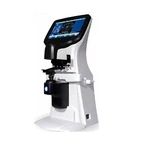
The appearance of the computer refractometer has brought great convenience to the modern optometry industry. Compared with the traditional retinoscopy mirror, the computer refractometer is easy to operate and easy to learn, which greatly improves the optometry efficiency of the optical shop. Its function is not limited to the pre-examination of the diopter, but also brings many guiding functions to the optometry work of the optometrist.