




Phoropter
What is Phoropter
A phoropter or refractor is an ophthalmic testing device. It is commonly used by eye care professionals during an eye examination, and contains different lenses used for refraction of the eye during sight testing, to measure an individual's refractive error and determine their eyeglass prescription.
Benefits of Phoropter
Precise Refraction Assessment: The phoropter allowsto precisely measure a patient's refractive error, including myopia (nearsightedness), hyperopia (farsightedness), astigmatism, and presbyopia. This precision is essential for determining the correct prescription for eyeglasses or contact lenses.
Binocular Vision Assessment: The phoropter helps assess how well a patient's eyes work together, including convergence (the ability to focus on nearby objects) and accommodation (the eye's ability to change focus from near to far). This assessment is crucial in diagnosing and managing binocular vision disorders and eye alignment issues.
Multifocal glass Lens Prescription: For patients requiring multifocal lenses (such as bifocals or progressives) to address both distance and near vision, the phoropter aids in determining the appropriate prescription for each portion of the lens, ensuring optimal vision at all distances.
Pediatric Eye Examinations: Phoropters are used in pediatric eye exams to assess children's vision and identify potential vision problems early. They help determine if children need prescription eyewear and assist in monitoring their visual development.
Customized Prescriptions: The phoropter allows eye care professionals to tailor prescriptions to the specific needs and visual preferences of each patient, optimizing visual clarity and comfort.
Specialized Testing: Phoropters are equipped with additional features for specialized testing, such as assessing color vision deficiencies, conducting contrast sensitivity tests, and evaluating glare sensitivity.
Efficient Examinations: The phoropter streamlines the examination process, allowing eye care professionals to accurately determine the most suitable prescription for the patient, enhancing the efficiency of the eye exam.

Why Choose us
Professional service
We can accept factory inspection and goods inspection at any time. Technical discussion, research and development of new products, and complete after-sales service.
Speed
Our organization is streamlined for fast turnaround on orders and immediate response to emergencies or unexpected opportunities.
Fantastic customer service
Nothing is more important to us than customer satisfaction. With our ‘can-do attitude’ we ensure our customers’ expectations are exceeded at all times – from delivering great solutions on time to providing advice and resolving queries as quickly as possible.
Quality and satisfaction
Taiyuan North China Xinyuan Tech Center(CO., LTD.)
The company has a complete quality management system and various qualification certificates.
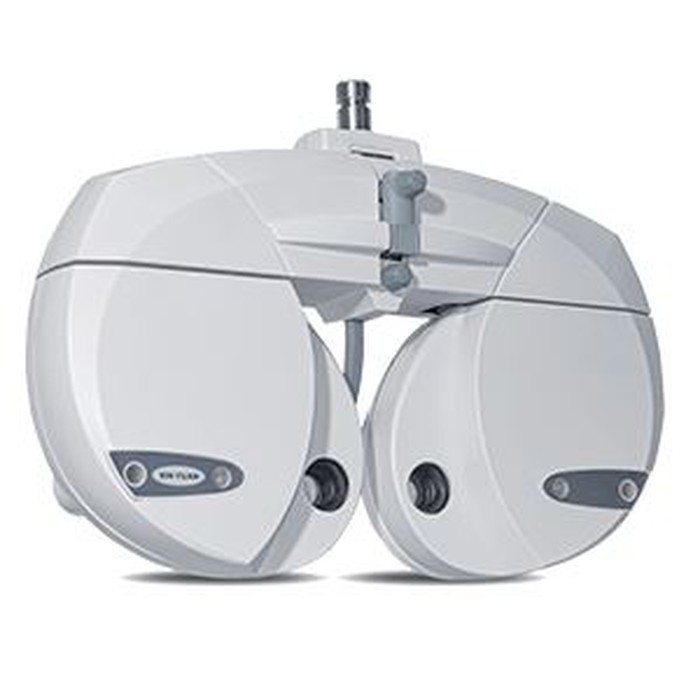
The process of switching lenses in front of your eyes is less involved than it may look, given the imposing nature of the device. A phoropter is used to manually determine “refraction”—exactly how a lens must be shaped and curved to correct your vision to a normal state, nothing more.
Phoropters are subjective however, based on your visual perception and response to your eye doctor's questions. Is your vision better, or worse? With this lens, or this lens? How about now?
There are other procedures and technologies available that automatically measure the refraction needed within your eye and produce a “prescription” measurement without your input. These are called autorefractors and aberrometers.
Demystifying the Mechanism: Manual vs Digital Phoropters
When it comes to a traditional manual phoropter, each component needs human intervention for adjustment. Take for instance the cross-cylinder, a critical piece that you manually manipulate to detect astigmatism. While this device can provide highly accurate measurements, it demands meticulous care and skill to operate. You manually set lens combinations for refraction analysis, including Sphere, Axis, and Cylinder. This hands-on appliance also helps in tuning the astigmatic axis measurements with no deviations.
Furthermore, some manual phoropters, are conceived to facilitate certain tasks. For instance, it allows for smooth and fast PD adjustments, which refer to Pupillary distance changes. The device features a dustproof mechanism and anti-reflection system. Superior to all is the easy PD adjustment with a single rotation for 6mm, making it simple and swift for practitioners.
On the flip side, we have digital phoropters, a more modern approach to the vision assessment process. They're equipped with automated components that negate much of the manual work. They come packed with an electronic drive refractor head that auto-displays power lenses, and a software panel that takes care of all data entries. A notable specification for a popular model like the VT-5 phoropter includes Sphere power range from -19 to +16.75 diopters, Cylinder power range from 0 to -6 diopters, and cylindrical axis ranges from 0 to 180 degrees.
One digital panel gets everything set in a digital phoropter. The automatic system proficiently detects the refractive errors and updates the vision prescription. The most significant advantage of these phoropters rests in their potential to prevent the multiple entries related to human error – as seen with manual phoropters. Think of it as your diligent assistant, freeing up valuable time for doctors to engage directly with their patients.
Both types of phoropters have their advantages and unique features. Whether you need a manual or digital phoropter, the key is to choose the one that best suits your practices and patient needs. And remember, a reliable supplier can provide you with top-quality devices with trade assurance. So, choose wisely!
What The Phoropter Can And Can't Do
Measure refractive error
The phoropter can help determine the correct prescription for corrective lenses, allowing an eye doctor to know the degree of nearsightedness, farsightedness, and astigmatism a patient has.
Test visual acuity
The phoropter can help test visual acuity or how well a patient can see at different distances, which is necessary to assess one's vision and determine the appropriate corrective lens prescription.
Determine binocular vision
The phoropter can help assess how well a person's eyes work together, essential for evaluating overall vision health.
Assess accommodative function
We can also use a phoropter can also be used to evaluate how well a patient can focus on objects at different distances, which is essential for diagnosing specific vision problems.
What a phoropter can't do
Diagnosing eye diseases
The phoropter is not meant for diagnosing eye diseases or conditions, like glaucoma or macular degeneration, which require other instruments like an ophthalmoscope or slit lamp.
Assess eye health
It's impossible to diagnose eye health issues such as dry eye or corneal irregularities using the phoropter. These require other instruments, such as a corneal topographer or keratometer.
Substitute a comprehensive eye exam
Although a phoropter can provide valuable information on a patient's prescription for corrective lenses, it cannot substitute a comprehensive eye exam meant for a complete assessment of a patient's overall eye health and function. An eye doctor may perform other tests and evaluations to ensure the patient's eyes are healthy and functioning correctly.
Step By Step Guide On How To Use A Phoropter
Phoropters is a common sight in Opticians now, we are not trained in them, so here is a step by step guide for beginners on using a phoropter.
Remember using a phoropter has the same routine as the trail frame.
Step 1. Check PD and enter it in to the phoropter:There should be a PD button which will open the option.
Step 2. Make sure the phoropter is leveled: There should be a level bubble and and instrument to adjust it. If the level is off the axis can be wrong.
Step 3:You can simply add your preferred working distance and start your Retinoscopy.
Step 4. Then go to your refraction, you can skip step 3 if you don't RET: The only difference between trail frame and phoropter is your wording. When doing BVS except of saying better with or without just change the wording to better lens 1 or 2, as the patient won't see a lens removed.
Step 5. Cross cyl is where people get confused
● When you don't know the where the astigmatism is, you should start with a -0.25 in the cyl section. Then press the axis button. On the bottom row see 4 axes, 0,45,90,135. Bracket your axis like you would normally would.
● When you have bracketed your axis, we need to refine it. Most phoropters have a central wheel and a cyl button on either side. This controls your cross cyl axis and power, acts the same as flipping it.
● Flip the cross cyl and instruct the patient, is the image clear and rounder with lens 1 or 2, and move the wheel in the direction of the patiens response. Keep going till you have found the axis.
● Now press the cyl button to change the power. Flip the cross cyl again saying is the image clearer and darker with lens 1 or 2, and move the wheel in accordance to the patient's response. Keep going till you've found the power.
Step 6. Finding the add:Measure the patients working distance. Once you've done that, press the add button which should automatically converge the PD's and add additional lighting (depending on your phoropter). There should be a add ruler and chart that is connected to the phoropter, bring that down and present the patient with the reading chart. Increase and decreases the add using the wheel until you've found the right prescription.
This step by step guide should get you started in how to use a phoropter, the more you use the instrument the more confident you will be. Exploring other aspect like prism and suppression is all possible on phoropters just, explore the option on the instrument you have.
Maintenance Tips for Comprehensive Phoropter
Emphasizing the Importance of Maintenance
Maintenance of your phoropter is critical for ensuring it's working condition. This can include regular cleaning, calibration checks, lubricating moving parts, or using protective covers. Professional maintenance checks will also go a long way in extending its lifespan and accuracy of results. Emphasizing the Importance of Maintenance Maintenance of your phoropter is critical for ensuring it's working condition. This can include regular cleaning, calibration checks, lubricating moving parts, or using protective covers. Professional maintenance checks will also go a long way in extending its lifespan and accuracy of results.
Mastery Through Practice
Familiarity is Key: Becoming skilled at using a phoropter refractor is about understanding the different lenses and their functions. You can increase your hand-eye coordination by regularly switching and manipulating lenses.
Quality Matters: Long-lasting performance of a phoropter relies heavily on its build quality. Seek out a sturdy model designed for regular use to ensure durability.
Added Features: Some interactive phoropters feature advanced technology allowing for automatic data import/export, saving valuable time in the examining room.
Regular Maintenance: A well-maintained phoropter ensures accurate readings. Regular cleaning, calibration, and lubrication can increase the longevity of the device.
Avoid Harsh Conditions: Exposing your phoropter to severe conditions, such as high heat or humidity, can impede its performance. Proper storage and protection are vital.
Accessory Compatibility: Ensure your phoropter model is compatible with any optical accessories or systems you plan to use, creating a more comprehensive eye examination experience.
Our Factory
Being more than 30 years, now we are a leading manufacturer of optical instruments in China. We have large quantities of professional technicians and skilled workmen. Many advanced optical-electricity equipments are used in the technological process. Depending on the scientific research advantage of North University of China, we have developed a multi factorial and multi directional produce, management and sale system.

Our Certificate
Taiyuan North China Xinyuan Tech Center(CO., LTD.) is a professional company that produces "Xinyuan" brand glasses industry test equipment.
The company has a complete quality management system and various qualification certificates.

Asked Questions
As one of the leading phoropter manufacturers in China, we warmly welcome you to buy high-grade phoropter for sale here from our factory. All customized products are with high quality and competitive price.
lens hand edger, lens auto edger, Phoropter